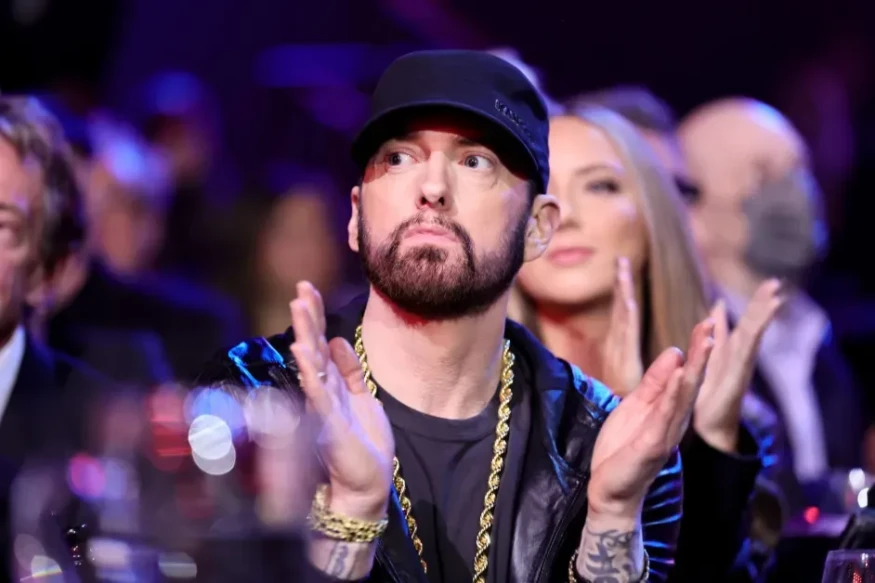
Eminem is at the center of a major legal development after former studio employee Joseph Strange admitted on October 22, 2026, that he copied and sold unreleased music without permission. The 48-year-old received about $50,000 from the illegal sales, while the files later appeared online. Strange now faces up to five years in prison, with sentencing scheduled for January 27, 2027.
Eminem is at the center of a new legal development after former employee Joseph Strange pleaded guilty to criminal copyright infringement involving unreleased recordings. The admission was entered in federal court in Michigan on October 22, 2026, bringing a major shift in a case that began after previously unheard music appeared online without the rapper’s approval.
Strange, 48, worked for Marshall Mathers, the artist better known as Eminem, for roughly 14 years. According to court records, he was employed between about 2007 and 2021 at a studio in Ferndale, Michigan, where the rapper stored and worked on music that had not necessarily been prepared for public release.
Part of Strange’s job involved setting up and operating computer systems used to store recordings. That gave him access to password-protected hard drives containing songs, demos, alternate versions and material at different stages of development.
That access was connected to his work and did not give him permission to copy, sell or distribute the files for his own benefit. The legal case centers on what prosecutors say happened after Strange used that access to remove music from the studio environment.
Court documents state that he copied at least 10 audio files without authorization. His guilty plea covers the unlawful copying and resale of those files and should not automatically be interpreted as an admission involving every unreleased Eminem recording that later surfaced online.
The sales took place between July and August 2024. Strange transferred at least 10 music files to buyers online and received approximately $50,000 in total.
Eminem did not know about the transactions and had not given permission for the recordings to be copied or sold. The files eventually moved beyond the original buyers and began appearing on public websites and listening platforms.
Once the material became publicly available, users shared and replayed the recordings even though they had never been officially released. That wider circulation helped trigger the investigation that eventually led authorities back to Strange.
The financial figures in the case describe two different things. Strange is said to have received about $50,000 from selling the recordings, while prosecutors estimated the copyright infringement itself at a value of at least $750,000.
Those numbers should not be treated as interchangeable. The $50,000 refers to money allegedly received through the sales, while the larger figure is an estimate connected to the value of the infringement in the legal case.
It does not mean Eminem has already received $750,000 in damages, nor does it mean Strange personally earned that amount. The figures serve different purposes and describe different parts of the case.
Digital data collected during the investigation also showed how widely the material spread after the leaks. By November 2025, the files identified in the case had reportedly been accessed more than eight million times online.
That figure refers to the combined activity around the identified recordings rather than one individual song. It illustrates how quickly unreleased music can move once it reaches public platforms, even when the original sale involves only a small number of buyers.
Prosecutors have said the recordings were in different stages of development. Some had received professional audio processing, which suggests that certain tracks may at one point have been considered for further use.
That does not mean the songs were definitely scheduled for release. Artists and producers routinely keep unfinished recordings, alternate takes, experiments and older ideas in studio archives without making any final decision about whether they will ever become public.
The distinction is especially important in Eminem’s case because unreleased material can include work spanning many years. The presence of a track on a studio hard drive does not necessarily mean it belongs to an upcoming album or was ever intended for commercial release.
When a larger batch of material surfaced online in early 2025, a representative for the rapper said the recordings included demos and unfinished music that had not been approved for release.
The position from Eminem’s team was that those recordings should not be treated as a fair representation of material he had chosen to complete and present publicly. Unfinished music can exist before final production, editing, rewriting or even complete abandonment.
Among the recordings discussed around the wider leak were collaborations involving 50 Cent and Dr. Dre. Reports also referred to an older 2003 track said to contain aggressive lyrics aimed at Suge Knight and Ja Rule.
Those details belong to the broader wave of leaked Eminem material and do not necessarily identify the exact 10 or more files covered by Strange’s guilty plea. The legal admission is narrower than the full collection of recordings that circulated online.
The investigation developed after those leaks attracted attention in 2025. Strange was charged in March of that year with copyright infringement and interstate transportation of stolen goods.
His October 22, 2026 guilty plea means he has now accepted responsibility for the criminal copyright infringement charge involved in the case.
Federal officials described the conduct as a serious abuse of trust. Because Strange had legitimate access to the studio and its computer systems as part of his employment, prosecutors argued that he used a position of responsibility to obtain material that belonged to someone else.
The case also highlights the difference between physical access and legal ownership. An employee can be authorized to work with files, move them between systems or maintain storage equipment without gaining the right to copy those recordings for personal use.
For Eminem, control over unreleased music is not only a financial issue. It also concerns when and whether a recording becomes public, how it is finished, what version listeners hear and whether the artist ultimately believes it should be released at all.
A leak removes that decision from the artist. Once unfinished recordings are uploaded or sold, they can continue circulating even if they were never intended to represent the final work.
Assistant Attorney General A. Tysen Duva described Strange’s actions as a misuse of the trust placed in him. He emphasized that copying and selling unreleased recordings affects both copyright protections and an artist’s ability to control his own creative work.
The defense has pushed back against parts of the public presentation of the case. Strange’s attorney, Wade G. Fink, argued that the circumstances are more complicated than the simplified version that has circulated publicly.
At the same time, Fink said his client has accepted responsibility and expressed remorse. That position does not change the guilty plea but could become relevant when the court considers sentencing.
The next major date is January 27, 2027, when Strange is scheduled to be sentenced. He faces a maximum possible sentence of five years in prison.
That maximum does not mean a five-year sentence is guaranteed. The final decision will depend on federal sentencing rules, the circumstances of the offense and the judge’s assessment of the case.
Until then, the guilty plea settles one of the central legal questions created by the leaks: a former employee has admitted copying and selling unreleased recordings without Eminem’s authorization.
What remains unresolved is the punishment. The sentencing hearing in January will determine the legal consequences of the sales, while the leaked music itself remains part of a wider problem that cannot easily be reversed once private studio files have entered the public internet.