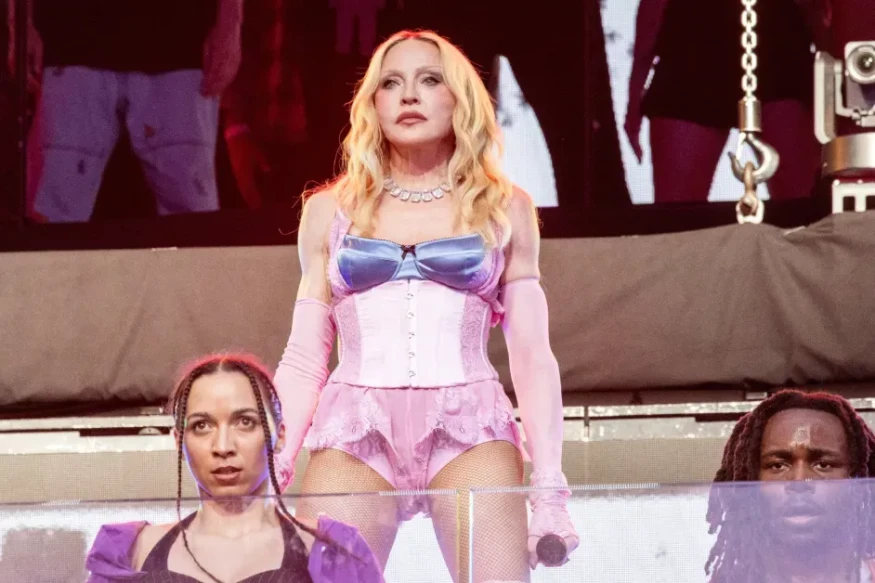
Madonna’s “CONFESSIONS II” Debuts at No. 1 as the Pop Icon Admits She Still Can’t Believe It
Madonna has returned to the top of the Billboard 200 with “CONFESSIONS II,” earning the tenth No. 1 album of her career. Despite decades of chart success and record-breaking achievements, the Queen of Pop says she is still overwhelmed by the response, describing the album as a project created with one simple goal: to make people dance, celebrate life, and experience music together once again.
Madonna is celebrating another milestone in one of pop music’s most remarkable careers. “CONFESSIONS II” has officially debuted at No. 1 on the Billboard 200, becoming the tenth chart-topping album of her career and proving once again that her ability to connect with audiences remains as strong as ever. Rather than treating the achievement as another expected success, Madonna responded with genuine emotion, admitting that she is still “pinching herself” after seeing the incredible reception to the record. For an artist who has spent more than four decades redefining pop music, the moment still feels surreal.
Shortly after the chart was confirmed, Madonna shared a series of photographs taken during “Club Confessions,” a special album release celebration held in Queens, New York. The images captured an intimate night filled with music, dancing, and longtime collaborators, including producer Stuart Price alongside Honey Dijon and Kaytranada. At the time the photos were taken, the Billboard No. 1 had not yet been announced. The evening was simply a celebration of the music itself—a reminder that dance floors have always been at the heart of Madonna’s creative vision. By the following day, however, the gathering had become part of an even bigger story.
“The words can’t express how grateful and surprised I am,” Madonna wrote while thanking everyone involved in the making of the album, as well as the fans who embraced it around the world. Her message reflected more than excitement over another chart achievement. Every new Madonna release inevitably arrives alongside conversations about legacy, longevity, and comparisons with earlier eras of her career. Questions about her place in modern pop culture often dominate headlines before listeners even hear the music. This time, however, the audience delivered the strongest possible response, sending “CONFESSIONS II” directly to the top of the charts.
Released on July 3, “CONFESSIONS II” serves as Madonna’s fifteenth studio album and features sixteen tracks that bridge generations of contemporary pop and dance music. The project includes collaborations with Feid, Martin Garrix, Lola Leon, Stromae, and Sabrina Carpenter, whose duet “Bring Your Love” also earned a place on the Billboard Hot 100. Rather than chasing current trends, Madonna uses these collaborations to build connections between her signature dance sound and some of today’s most influential artists. The result feels less like a nostalgic sequel and more like a modern evolution of the musical universe she helped create decades ago.
The album’s title naturally recalls “Confessions on a Dance Floor,” the landmark 2005 record that re-established Madonna as one of dance music’s defining voices. Yet “CONFESSIONS II” is far from a simple attempt to recreate the past. Throughout her career, Madonna has consistently resisted becoming trapped by nostalgia. Instead, she revisits familiar themes through a contemporary lens, presenting the dance floor not as a memory but as a living, shared experience. The album invites listeners to embrace the present rather than simply relive former glory.
That philosophy is reflected in Madonna’s own explanation of the project. “I wanted to make people dance this summer,” she said. “I wanted to bring joy.” Those few words summarize the essence of “CONFESSIONS II” more effectively than any marketing campaign ever could. Rather than focusing on commercial expectations or chart ambitions, Madonna returned to one of pop music’s simplest and most powerful ideas: great songs can change the mood of an entire room and bring people together through movement, energy, and celebration.
The visual identity of the project was introduced even before the album’s release through “Confessions II—The Film,” which premiered at the Tribeca Festival. Featuring six songs from the record—including “I Feel So Free,” “Good for the Soul,” “One Step Away,” “Bring Your Love,” “Danceteria,” and “Read My Lips”—the film reinforced Madonna’s long-standing belief that music and visual storytelling are inseparable. Since the earliest days of MTV, she has understood that pop is not only something audiences hear—it is something they experience through imagery, movement, and performance.
With “CONFESSIONS II,” Madonna now reaches an extraordinary milestone: ten No. 1 albums on the Billboard 200. The achievement makes her the first female artist to score Billboard 200 No. 1 albums across four different decades, extending a legacy that has survived every major transformation of the music industry—from vinyl and CDs to downloads and streaming. Each generation has introduced new challenges, yet Madonna has repeatedly found ways to reinvent herself while remaining unmistakably true to her artistic identity.
Just one night before Billboard confirmed the chart-topping debut, Madonna was simply surrounded by friends, collaborators, and fans dancing together in Queens. She had no official confirmation that “CONFESSIONS II” would soon become another No. 1 album. Hours later, she would tell the world that she could hardly believe it herself. For an artist whose career has been defined by constant reinvention, perhaps the most meaningful image of this moment is also the simplest: a dance floor full of people, music playing loudly, and a dream that continues to become reality.