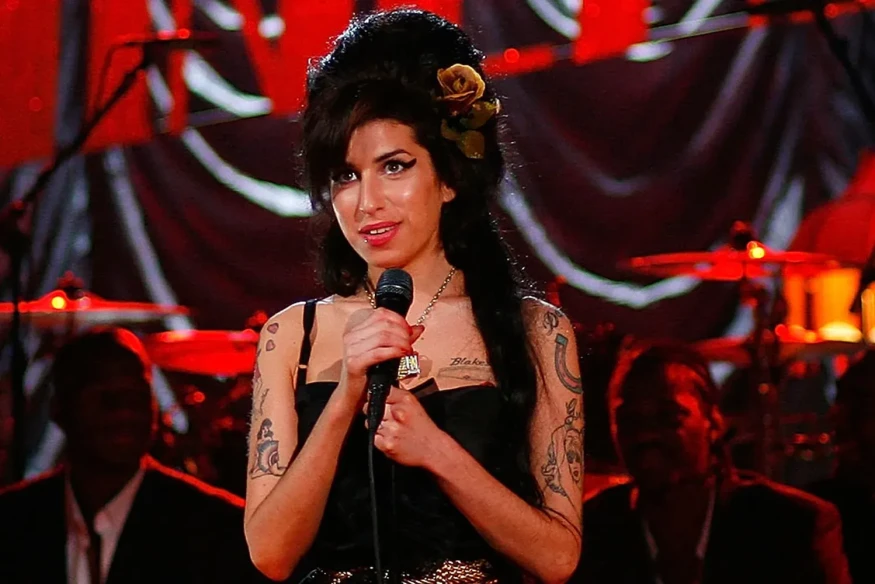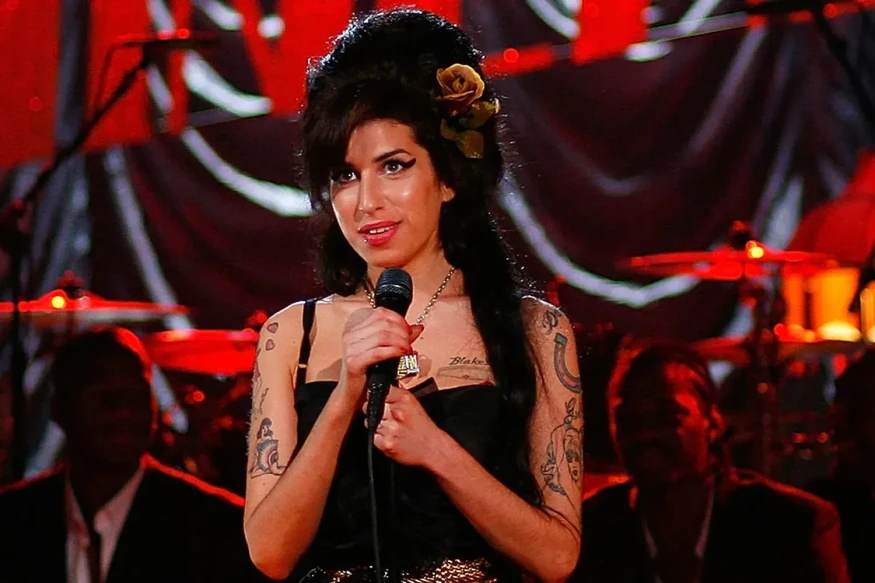
Fifteen years after Amy Winehouse’s death, her mother is returning to a truth that was often lost behind the mythology: her daughter was not simply a brilliant singer who destroyed herself, but a vulnerable woman trapped by addiction. Janis Winehouse is reflecting on fame, insecurity and a decline that the world seemed to watch almost in real time.
Amy Winehouse died on July 23, 2011, at the age of 27, inside her home in Camden, north London. By the time emergency services arrived, they could do nothing to alter the ending of a story that had already unfolded in public through headlines, concert footage, photographs and relentless scrutiny. Her death was later attributed to accidental alcohol poisoning. Fifteen years later, Janis Winehouse does not speak about her daughter as a distant symbol of pop culture. She remembers the child she lost — a young woman whose extraordinary success could never protect her from what was happening inside her.
One of Janis’ most striking observations remains brutally simple: addiction becomes the authority. It is a perspective that cuts through years of easy judgments about Amy’s life, when dependency was frequently treated as a lack of discipline or a collection of bad choices that could have been corrected if she had simply tried harder. That interpretation ignores the biological, psychological and emotional power addiction can exert. Once the body and mind begin demanding relief, logic alone is rarely enough. “Just stop” sounds straightforward only to people who have never watched someone they love become trapped inside that cycle.
Behind the towering beehive, heavy eyeliner, tattoos and swagger that became instantly recognizable around the world, Janis remembers a deeply nervous person. She believes Amy’s lack of confidence played a significant role in the way alcohol and drugs became places of escape. Drinking could temporarily soften anxiety, dull fear and create distance from whatever hurt most. But that relief came with a cost. What initially appeared to offer control gradually demanded it instead. The substance that quieted the anxiety for a few hours ultimately returned it with greater force, creating another need to escape and tightening the cycle.
Amy became globally famous because she possessed an almost frightening ability to turn emotional disorder into songs that felt completely exposed. On Back to Black, she did not hide behind carefully designed pop personas or vague metaphors. She wrote about abandonment, obsession, jealousy, self-sabotage, desire and humiliation with a voice that sounded older than the woman producing it. Her success was enormous, yet Janis has often suggested that Amy never seemed entirely equipped to absorb the attention surrounding her. What sometimes appeared to outsiders as charming awkwardness was also evidence of the distance between her public confidence and her private sense of security.
As her voice became more valuable to the music industry, her private life became increasingly valuable to another industry: celebrity surveillance. Jane Winehouse, the wife of Amy’s father Mitch and an active figure in Amy’s Place, has described photographers waiting outside the singer’s home from morning until night. They were not simply hoping to photograph a celebrity leaving her house. They were waiting for deterioration. A stumble, an argument or a visibly difficult moment could become another profitable image in an unfolding story of decline. Amy was rarely given the space to be unwell privately. Every fracture could become a photograph, every setback a headline.
That is perhaps the most uncomfortable part of her legacy. The public did not discover after her death that Amy Winehouse had been in serious trouble. Everyone could see it happening. The entertainment industry, the press and audiences watched a young woman steadily lose control while still expecting performances, interviews and new music. After she died, the tone changed almost instantly. Mockery gave way to mourning. The same culture that had consumed her instability as entertainment began celebrating her as a lost genius. The affection was real, but it could not erase how closely her suffering had been followed — and monetized — while she was alive.
Ronnie Wood has recalled moments when he tried to help Amy before performances. The Rolling Stones guitarist shared the stage with her at the Isle of Wight Festival in 2007 and understood that what appeared to be a bottle of water might not necessarily contain water. He would encourage her to focus and get through the performance. His memories capture the contradiction at the center of Amy’s final years: backstage there could be anxiety, uncertainty and chaos, yet once she reached the microphone, the talent could temporarily overwhelm everything else.
That ability may also have made the seriousness of the situation easier for people around her to rationalize. As long as Amy could still walk onto a stage and produce an extraordinary performance, there was an illusion that enough control remained for the machinery surrounding her to keep moving. A person can be profoundly unwell and still perform brilliantly; the two conditions are not mutually exclusive. In Amy’s case, however, the extraordinary power of her voice could sometimes function as evidence that she was still capable of continuing, even when much of the rest of her life suggested she needed distance, treatment and protection instead.
Her family has since attempted to transform part of that loss into practical support through the Amy Winehouse Foundation and Amy’s Place, which works with women recovering from addiction and trying to rebuild their lives. For Janis, that work does not remove grief. It gives grief somewhere to go. She has spoken about continuing forward because that is the only way she knows how to live. It is not a declaration that she has somehow made peace with losing her daughter. It sounds closer to the mechanics of survival — learning how to continue carrying an absence that never truly disappears.
The anniversary also arrives with another reminder of Amy’s continuing musical influence. Rolling Stones recorded a version of “You Know I’m No Good” for the album Foreign Tongues, returning to one of the songs most closely associated with her ability to expose her own contradictions. The title has often been interpreted retrospectively as though Amy understood and almost predicted her own destruction. But self-awareness is not treatment. Recognizing the behavior that is hurting you does not automatically provide the ability to stop it. The song remains an extraordinary confession, not evidence that she somehow accepted the outcome that followed.
Fifteen years later, Amy Winehouse exists simultaneously as a voice, an image, a tragedy and a warning. Her recordings remain extraordinarily alive, while the mythology around her continues to grow with every anniversary, documentary, tribute and new interpretation of her work. Janis Winehouse keeps returning to the person beneath all of it because that may be the part of Amy’s story most vulnerable to disappearing. The music will continue to play. The photographs will remain. But Amy’s Place and the foundation carrying her name continue working with people for whom addiction is not a cultural memory or a cautionary tale — it is something they are fighting today.