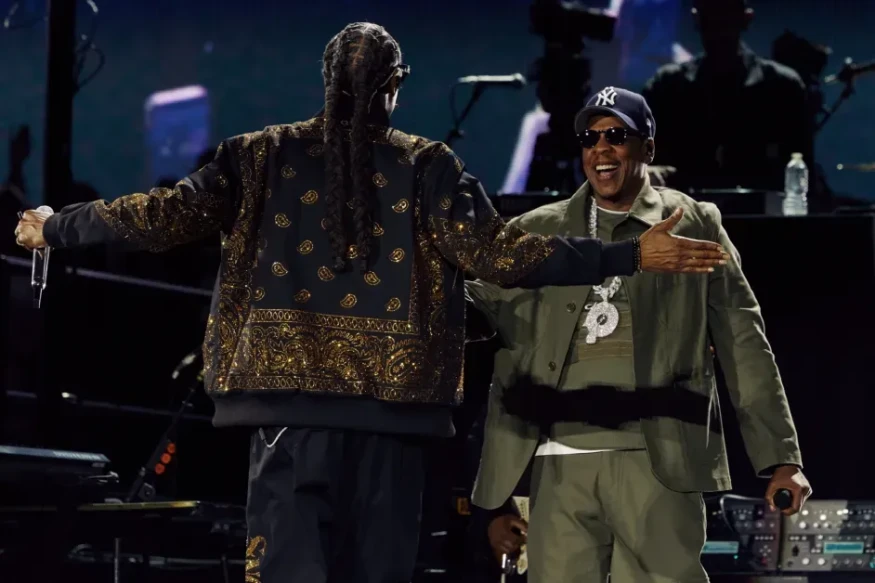
Jay-Z closed the “JAŸ-Z30” anniversary run with a major Los Angeles finale at SoFi Stadium on October 24, 2026, bringing Dr. Dre, Snoop Dogg and Too $hort into a show built around three decades of his catalog. The night included a four-song West Coast section led by Dre and Snoop, before Jay-Z returned for the final stretch and ended the tour with “Encore.”
The final night of “JAŸ-Z30” turned SoFi Stadium into a meeting point between New York and West Coast hip-hop. The rapper ended the anniversary concert series with a two-hour set that moved through different eras of his career, while making room for guests whose own histories helped shape rap across several decades.
The concert took place on Saturday, October 24, in Inglewood, California, and was the second of two scheduled nights at the stadium. Jay-Z opened with “The Watcher 2,” choosing a different introduction from the previous evening and immediately setting up a performance that would not simply repeat the first Los Angeles show.
“The Watcher 2,” from 2002’s “The Blueprint 2: The Gift & The Curse,” also provided a natural bridge into the first guest moment. Soon afterward, Jay-Z moved into a version of “Blow the Whistle,” creating the opening for Too $hort to appear onstage and take over his 2006 hit.
Too $hort’s entrance brought a different branch of West Coast rap into the show. The Oakland veteran has been recording since the 1980s, long before Jay-Z released his debut album, and his appearance gave the anniversary concert a wider historical frame than a simple celebration of one artist’s discography.
After Too $hort left the stage, Jay-Z continued through songs from multiple periods of his catalog. “Izzo (H.O.V.A.)” was followed by material including “Beach Is Better,” “Run This Town,” “Family Feud” and “Dirt Off Your Shoulder,” while older cuts such as “Dead Presidents” and “D’Evils” kept the set connected to his earlier years.
The biggest shift of the night came when “D’Evils” moved into the sound of “Murder Was the Case.” Snoop Dogg emerged first, bringing the audience directly into the sound of early-1990s California rap before Dr. Dre joined him for a self-contained section that temporarily changed the identity of the concert.
Jay-Z stepped back and let the pair control the stage. Their first major selection was “The Next Episode,” one of the best-known collaborations from Dr. Dre’s 1999 album “2001.” More than 25 years after its release, the track still functions as one of the clearest signatures of the partnership between Dre and Snoop.
The pair then moved into “California Love,” the 2Pac and Dr. Dre classic that remains closely tied to the image and sound of California. Performing it in Los Angeles gave the song an obvious sense of place, turning the stadium into a celebration of West Coast rap before the set moved even deeper into that history.
“Nuthin’ but a ‘G’ Thang” followed, bringing the focus back to “The Chronic,” Dr. Dre’s 1992 album and one of the defining records of G-funk. Snoop Dogg’s role in the original track was crucial to his own rise, and hearing the two perform it together more than three decades later gave the segment its strongest historical connection.
The four-song run closed with “Still D.R.E.,” another centerpiece from “2001.” That choice also carried a direct link back to Jay-Z, who famously wrote Dre’s verses for the track. The moment connected the host of the night to the West Coast section without requiring him to join the performance itself.
The Dr. Dre and Snoop Dogg appearance was presented as a celebration of existing classics, not a launch for new material. No unreleased song was introduced and no new collaboration was announced. Instead, the pair used their time to move through a short sequence of tracks that defined different stages of their shared career.
Elsewhere in the show, Jay-Z also paid tribute to Nipsey Hussle. Elements of “Hussle & Motivate” were worked into “Hard Knock Life,” while “On to the Next One” incorporated the instrumental from “Last Time That I Checc’d.” The tribute stayed within the music and the visual production rather than bringing another guest to the stage.
After Dre and Snoop finished their section, Jay-Z returned to the microphone and took back control of the show. The second half included “99 Problems,” “Excuse Me Miss” and “Jigga My Nigga,” before moving into some of the biggest crowd moments of the night.
“Empire State of Mind” brought New York back into a stadium that had just spent several minutes immersed in California rap. “Big Pimpin’” followed among the late-set selections, reinforcing the sense that the finale was designed as a broad career retrospective rather than a performance focused on one album.
The closing sequence moved through “Public Service Announcement” before arriving at “Encore.” That final song gave the anniversary run a fitting endpoint, especially because it comes from 2003’s “The Black Album,” a record once presented as Jay-Z’s farewell before he ultimately returned to music.
The “JAŸ-Z30” concerts were built around two major anniversaries: 30 years since “Reasonable Doubt,” released in 1996, and 25 years since “The Blueprint,” released in 2001. The shows had already passed through New York, London and Paris before reaching their final destination in Los Angeles.
The second SoFi Stadium night was intentionally different from the first. On the previous evening, Jay-Z had been joined by Blue Ivy Carter, Scarface, John Legend and DJ Khaled. The October 24 finale shifted the guest focus toward West Coast history, with Too $hort, Snoop Dogg and Dr. Dre providing the major surprises.
Several other artists were in the audience rather than onstage. Lizzo, Kelly Rowland, Wizkid and DJ Khaled were among the familiar names spotted at the show, but their presence was separate from the planned guest appearances inside the set.
That distinction kept the structure clear. Jay-Z remained the center of the concert, while each guest was given a specific place rather than turning the night into an extended all-star relay. The Dre and Snoop section was the largest departure from his own catalog, but it still fit the larger idea of a career celebration staged in Los Angeles.
The location also brought another topic into the conversation. SoFi Stadium is scheduled to host Super Bowl LXI in February 2027, and Jay-Z’s presence at the venue had already encouraged speculation about possible involvement in the halftime show.
Nothing was announced during the concert. The final “JAŸ-Z30” date stayed focused on the anniversary run itself, and there was no confirmation of a Super Bowl appearance or any other future event connected to the stadium.
That made the ending more straightforward. The night was not used as a launchpad for another major announcement; it was allowed to function as the closing chapter of the tour.
For Jay-Z, the final Los Angeles show brought together the two geographic poles that have defined so much of American hip-hop history. His own catalog carried the night, but the presence of Too $hort, Snoop Dogg and Dr. Dre turned part of the finale into a direct salute to the West Coast.
By the time “Encore” arrived, the anniversary series had completed exactly what its concept promised: a long look back at Jay-Z’s career, but without limiting the story to him alone. The SoFi Stadium finale ended with his own music, after briefly handing the stage to artists whose work helped shape the wider culture surrounding it.